Educational Activities at Konza Prairie
Educational Programs on Konza Prairie
The Konza Environmental Education Program (KEEP) offers educational programs for school groups. Our trained volunteers ("docents") will lead your group in an activity that highlights the biology, geology, ecology, and history of the tallgrass prairie. If you wish to simply visit our Nature Trail without a docent guide, you do not need to contact our office.
Home school groups are welcome for ages 5 - 18 only. We will group children of a similar age into a group.
If you wish to schedule a guided visit for your school group:
- call: (785) 587-0381
- email us at Keeped@ksu.edu.
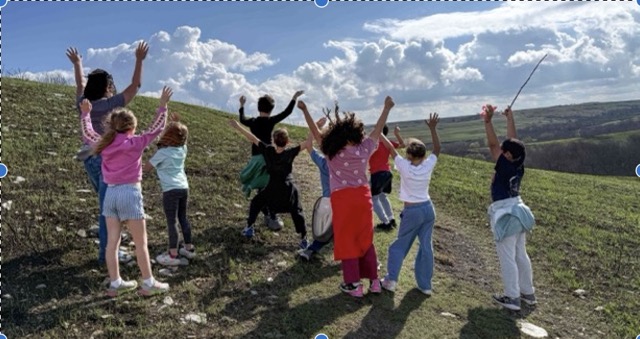
Guided Hikes and Tours:
- Nature Trail Hike - you may either have a hike guided by one of our trained naturalists or you may take your class on the trail yourself. The trail is 2.6 miles long and you can expect it to take 2 - 2.5 hrs. Because of the length of the hike and challenging terrain, this hike is not recommended for children younger than 2nd grade.
- Butterfly Hill Hike - this is an easy hike for all ages, but must be done with the guidance of a trained Konza naturalist. This trail is located around the restricted headquarters area and is not part of the public trail system. Expect it to take 1 - 1.5 hrs.
- Hokanson Homestead - this pioneer home site offers insight into the life of a homesteading family in the late 1800’s. The Hokanson Homestead still has the actual barn built by the Hokanson family and other original remnants to give visitors clues to life at that time. The area will show students what a gallery forest looks like near a prairie stream and how a pioneer family settled in a prairie area. Groups can walk from the Trail kiosk back to the Homestead and then return to the kiosk. Expect the roundtrip to take 1 - 1.5 hrs. It is an easy walk for all ages.
- Bison Loop Driving Tour This is a tour of the 10-mile Konza Bison enclosure. A Konza naturalist will accompany your class and share information on the bison herd management, survival, and prairie ecology. This is a fun activity that your students will remember for years. Expect a full loop tour to take 1.5 hrs. NOTE: KPBS does not have a bus or van for this event - the group requesting a tour must provide the vehicle to transport all participants together.
- Watching Wildlife on the Prairie - your class would learn how to move quietly through three different habitats taking note of the different sights and sounds around them. This activity teaches kids how to pay attention to their environment and "see" what is happening in their world. Time required is 45 minutes - 1 hr.
- Konza Experience - this activity is in cooperation with the Flint Hills Discovery Center (FHDC). Groups visit both the FHDC and Konza Prairie doing a specific scavenger hunt worksheet at each place. By putting both experiences together, visitors get an excellent taste of what the tallgrass prairie is all about. Allocate 1.5 hrs. at each site with at least 30 minutes travel between locations.NOTE: there is a separate charge for admission into the FHDC and the group requesting the activity is responsible for making the reservations with the FHDC.
Hands-On Science Activities:
- Survey of Grasshoppers on the Prairie - students learn how to systematically capture grasshoppers on two different sites and then learn the differences between species of grasshoppers. They learn about transects and the completion of data forms. Allocate 1 - 1.5 hrs. for this activity.
- Effects of Fire on the Prairie - students work as teams of 2 or 3 to investigate the effects of fire on the prairie near the Konza Prairie headquarters area. They are assigned specific areas on the prairie to evaluate the presence of grasses, forbs, and wooded plants. Students also learn how to fill out a data form correctly and work as a team. Allocate 45 minutes - 1 hr. for this activity
- Grazing Ecology - students assess the effects of grazers - bison and cattle - on the biodiversity of the prairie. Allocate 2 hrs. for this activity.
- Observing the Prairie - students work in teams of 2 to make observations of animals in three different areas of the open prairie: (1) bison grazed/burned every other year, (2) ungrazed/burned annually, and (3) ungrazed/burned every 4 years. They learn how to see life around them and to better understand how land management affects animal life.